Coffee, Climate, and the Future of India’s Value Chain
Coffee is not a linear story.
From the cup to the farm, everyday choices, climate pressures, and value-chain decisions interact in complex ways — shaping whether coffee systems move toward resilience or increasing vulnerability. This whitepaper takes a systems view of India’s coffee value chain to explore those interactions.
Who this paper is for
This paper is intended for:
Coffee brands and roasters engaging with sustainability beyond surface
Policymakers and development practitioners working at the
Climate and impact financiers assessing long-term risk and resilience in
Practitioners and researchers seeking grounded, systems-level perspectives
Readers curious about how everyday coffee choices connect to larger
Who this paper is by
This whitepaper is authored by FCF India. Our work focuses on agri-value chain systems where climate, livelihoods, markets, and data intersect. We engage with complexity directly — recognising constraints, trade-offs, and long-term outcomes rather than simplifying them away. This paper reflects how we think, observe, and work in practice.
Authors
Shreya Garg
Syed Ahmad Kamran
Nishant Ganvir
Inside the maze
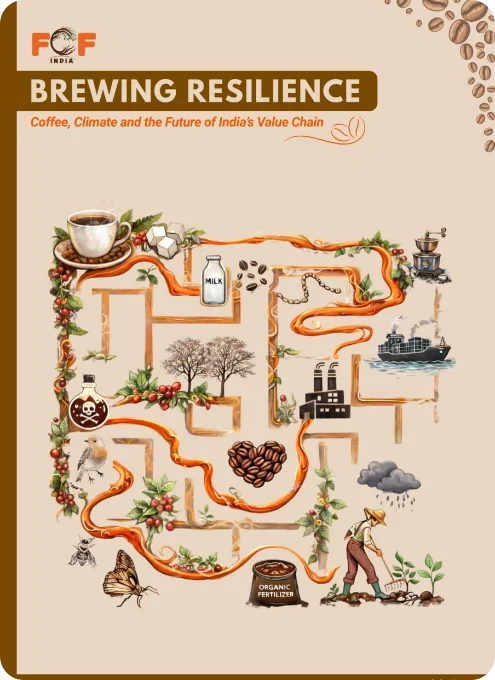
The maze illustrated on the cover represents the coffee system itself — interconnected, constrained, and shaped by cumulative choices.
Each section below explores one part of that system.
Consumption
Carbon Financing allows businesses and smallholder farmers to earn revenue by implementing carbon-reduction/removal projects. These projects generate carbon credits, which are sold in compliance or voluntary markets, supporting sustainable development.
Processing & Trade
Projects must reduce or remove greenhouse gas (GHG) emissions and fall under categories like: ✔ Nature-Based Solutions – Agroforestry, afforestation, mangrove restoration ✔ Renewable Energy – Solar, wind, biogas, and hydro projects ✔ Waste Management – Biogas, composting, circular economy models ✔ Sustainable Agriculture – Low-methane rice farming, regenerative agriculture, among many more.
Agronomy & Inputs
We help organizations: ✔ Assess feasibility and partner with local communities ✔ Quantify emissions reductions using international methodologies ✔ Register projects under Gold Standard, VCS, or other global frameworks ✔ Sell credits by connecting projects with investors and corporate buyers
Ecology & Biodiversity
MRV ensures transparency in carbon projects by: ✔ Tracking emissions reductions ✔ Independently verifying data ✔ Ensuring compliance with carbon crediting standards
Resilience
MRV ensures transparency in carbon projects by: ✔ Tracking emissions reductions ✔ Independently verifying data ✔ Ensuring compliance with carbon crediting standards
Inside the maze
Climate risk in coffee systems extends far beyond the farm gate
Isolated solutions cannot compensate for system-level pressures
Smallholder constraints shape outcomes more than individual intent
Traceability improves visibility but does not automatically ensure resilience
Trade-offs are unavoidable — ignoring them weakens the system
Why FCF India is working on this
At FCF India, our work focuses on agri-value chain systems where climate, livelihoods, and long-term impact intersect. This whitepaper reflects how we think — and how we engage — across agriculture, climate finance, and sustainability initiatives.
Read the Full Whitepaper
The full paper expands on these observations with analysis, data, and practitioner perspectives.
It is intended for policymakers, practitioners, financiers, coffee businesses, and others engaging seriously with the future of coffee in India.